Five deacon candidates instituted as acolytes
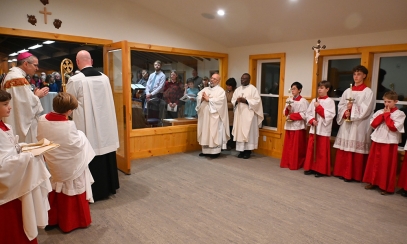
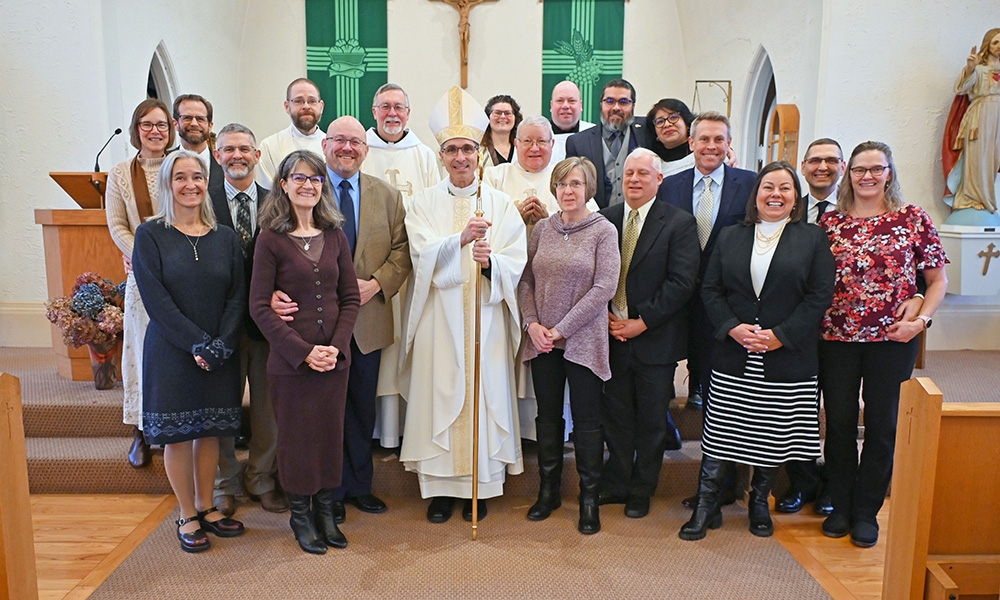
Asking God to bless them and to grant that they may be faithful in the service of His altar, Bishop James Ruggieri instituted five deacon candidates into the ministry of acolyte during a Mass celebrated at Sacred Heart Church in Hallowell.
Acolytes assist priests and deacons in liturgical celebrations, especially in the celebration of the Liturgy of the Eucharist. An acolyte’s service includes the responsibilities of an altar server, a sacristan, and an extraordinary minister of holy Communion.
“The mystery of acolyte is first and foremost a call to deeper communion with Christ,” Bishop Ruggieri said. “Your service at the altar is an act of unity. It’s an expression of the bond that holds the Church together in Christ. By this instituted ministry, your service to the Church, you are servants of Christ the servant. Your relationship with the Lord is shaped at the altar where He gives Himself for the life of the world. Here, at the altar, you will learn the rhythm of Christian discipleship: to receive before you give, to be nourished before you nourish, and to be loved before you speak of love.”
It was a message that hit home for the newly instituted acolytes.
“The bishop’s words that resonated with me today were that we’ll have the opportunity to serve at the altar, but receiving before you can give, loving Christ in the Eucharist before you can give back to the people of God, being formed at the altar before you can form others within the Church. Those are the things that are meaningful,” says Douglas Guerrette of Hampden.
“You can’t serve unless you’re served. You can’t give unless you’ve been given to. You can’t love unless you’ve been loved first. All of those resonate strongly with me as I start to think about that service at the altar,” says Peter Koch of Rumford.
Along with Guerrette and Koch, the other newly instituted acolytes are Arturo Juarez-Ayala of Yarmouth, Adam Stearns of Skowhegan, and Timothy Winkeler of Falmouth. Three other deacon candidates — Peter Czerwinski of Readfield, Stephen Ritchie of Eliot, and Richard Roussel of Gorham — were previously instituted into the ministry of acolyte.
“What I experienced today was a gift. I received a gift from God, a new ministry. It means that I need to give back to my brothers and sisters. I need to serve them as an acolyte,” says Juarez-Ayala. “I am not doing this for me. I do this for them, and whatever I do, I need to do it with love.”
During the Mass at Sacred Heart, which was celebrated November 22, the bishop prayed over the five men, asking God to bless them and to “grant that they may be faithful in the service of your altar and in giving to others the Bread of Life.”
As each man knelt before the bishop, he handed them a paten with bread to be consecrated, saying, “Take this vessel with bread for the celebration of the Eucharist. Make your life worthy of your service at the table of the Lord and of His Church.”
Although the men are discerning whether they are called to the permanent diaconate, the bishop stressed that becoming an acolyte is more than just a step on that journey.
“The acolyte stands at the meeting point of worship and mission, the place where heaven touches earth and from which the Gospel flows out into the world: homes, workplaces, hospitals, prisons, and every place where people struggle to believe that God has not forgotten them,” the bishop said. “You are called to be those who heal division, who reconcile, who listen, who accompany, who speak the truth with love, and who stand with the little ones and the forgotten. We could say that this is Communion in action. This is eucharistic charity made visible. This is the mission that begins at the altar and so beautifully extends to the very edges of human life.”
“It’s moving forward in the process of formation for the diaconate and is a step that brings us closer to Christ the servant and to serving the people in our parish as well as the people in general,” says Stearns.
“It’s a part of us being changed. As Christians, we’re all called to constantly be transformed,” says Winkeler. “This means that we are being formed, and the Eucharist is the center of our lives and will be the center of our lives even more so as we get closer to our potential ordination as deacons.”
The deacon candidates have another six months of formation and discernment, but if they are called to orders, they will be ordained to the permanent diaconate in the fall.
“The acolyte stands at the meeting point of worship and mission, the place where heaven touches earth.”
—Bishop James Ruggieri