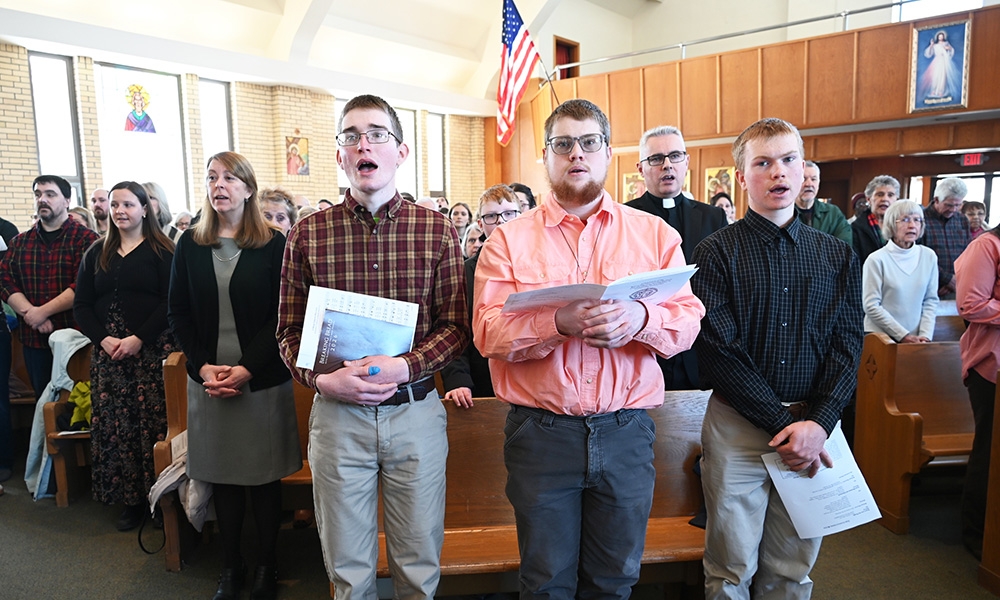
Finding a spiritual home at St. Paul the Apostle Parish
“God is loving because God is love.”
It is a belief at the heart of our Catholic faith and one that Deacon Luis Sanclemente is sharing with a group of more than 30 teens and adults gathered at St. Joseph Church in Brewer.
“God doesn’t love us with conditions. God loves us regardless of what we do,” he tells those gathered.
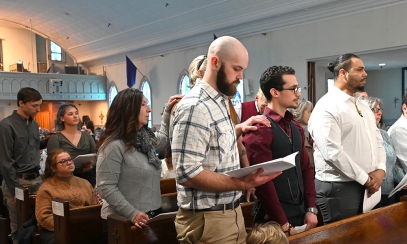
Those present are all participating in the Order of Christian Initiation of Adults (OCIA). Forty-eight people from St. Paul the Apostle Parish in Bangor will be baptized or receive the other initiation sacraments this Easter. Another 21 are expected to receive the sacraments this summer.
Some have little faith background. Others were raised in other Christian traditions. But they all share one thing in common.
“I just really felt called to the Catholic Church,” says Emmalyne Godin of Bangor. “I’m really looking forward to confirmation. I really want to receive the Eucharist.”
“I feel like God loves me and that He loves me through the Catholic Church,” says Charles Gardner of Holden. “That’s His house, His home, and He wants me there, and I want to be where God wants me. I’m not here because I want to be. I’m here because I was invited. I was invited and I said yes.”
Charles Gardner
Charles admits it’s not an answer he would have given earlier in his life. While he has now been sober for 19 years, he describes himself as someone who once behaved badly.
Charles says he was first introduced to Catholicism by his father and stepmother. He says when he first met his father, at age 19, his father was someone who drank heavily. He says, however, that his father underwent a transformation after marrying a devout Catholic woman.
“His whole demeanor changed,” says Charles. “He became very involved in the Catholic Church in California. They would have a rosary group. I didn’t even know what a rosary was.”
Despite being surrounded by Catholicism, Charles says he was not ready to welcome God into his own life. He says, for instance, when he joined Alcoholics Anonymous, he took a decidedly secular approach to identifying a higher power in his life.
“My higher power would be things like a ‘gift of desperation,’ or ‘group of drunks,’ ‘or good orderly direction,’ all these acronyms for god,” he says. “I got clean. I got educated. I got employed. I got married. I became a homeowner. I made amends to my family members, but there was this soul sickness within me.”
That emptiness wouldn’t be filled for several years, until after his father and stepmother had passed away. He credits Ed French, a member of St. Paul the Apostle Parish and an outreach coordinator with Catholic Charities Maine Parish Social Ministry, for bringing him to the Church. Charles, who is a clinical therapist and a former drug and alcohol counselor, was invited to speak to a group of parishioners.
“When I came into the church, it’s almost like I could hear my stepmom and my dad’s voice,” he says. “I just felt this warmth. And then, I was out in the parking lot talking to Ed, and then he came by the office and said something about this catechism.”
Charles says he agreed to begin OCIA to learn more about Catholicism and to perhaps better understand his father’s experience. He says he came armed with a lot of questions.
“Every question I was asking was an intellectual maze [I constructed] to keep me away from how I was feeling. I was feeling empty,” he says.
For the first time in his life, Charles says he felt a true higher power at work.
“I feel like there is a divinity, a divine presence, an energy,” he says. “I feel like there is this army of saints whispering to me and pulling me.”
He says he also feels his father’s presence.
“When I read the Bible, when I say the Rosary, it’s almost like I can feel my father’s arms around me,” he says.
Charles says he now can’t wait to attend Mass.
“It’s Wednesday night, and I’ve already been thinking about my Sunday morning,” he says. “When I go into the church, it’s almost like I can see the body of Christ lying on the table to be sacrificed. It’s not metaphorical. I really feel a closeness.”
He says that he feels the Spirit of the Lord running through him.
“I feel that Christ is alive. He’s pulling me in, or the Holy Spirit is pulling me in and the Virgin Mary,” he says. “It’s like a love story.”
Emmalyne Godin
Unlike Charles, Emmalyne says she has always felt a closeness to God.
“I’ve always relied on my faith my whole life,” she says. “I know that I have a Heavenly Father who loves me and cares about me.”
Emmalyne was baptized as a Baptist but was introduced to Catholicism through her husband. She says when they first met, they decided to attend a nondenominational church together, but her husband felt called back to Catholicism, leading her to do some online research.
“We started watching some friendly debates between Catholic priests and nondenominational pastors or Baptist pastors that kind of got my wheels turning,” she says. “I really liked some of the answers from the priest, so over a few months, I kept watching more videos, and I found myself more interested. And there was a certain point where I was kind of like, this makes more sense to me than what I’ve been taught.”
She says while attending the Baptist church, some of the answers she received to her questions seemed ambiguous, but in the Catholic Church, she found better guidance.
“At least in my experience so far, there just seems to be an answer for everything in the Catholic Church,” she says.
Emmalyne says she appreciated the Church’s long history, something that also resonated with Taylor Greener and Brandon Archibald, other members of the OCIA class who, like Emmalyne, were raised in Protestant traditions.
“I really like how old it is because I feel that says a lot about a Church, and it creates almost a chain of custody of information,” says Emmalyne.
“The closer I got into the history and into Scripture, everything just started to make sense,” says Brandon, who is from Bangor.
“I was able to see in the tradition within the Catholic Church that there was more evidence as far as the power of God,” says Taylor, also from Bangor. “There are people out there that I can look back on in history books, not just from anecdotal evidence. Like Padre Pio and Maximilian Kolbe, a lot of what they have to say really helps to ground and validate what I’m understanding about God.”
Taylor Greener
Taylor says he had stepped away from the Protestant church he was attending because it didn’t feel right. He says it was his wife, a cradle Catholic, who introduced him to Catholicism.
“My wife had reached out and had formed a very strong bond and connection with a lot of people in the parish, and then she brought me along,” he says.
In the Protestant Church, he says he felt there were more social demands on him, but now he feels like he can progress at his own pace.
“It’s the sense that I’m not being as driven to perform, if that makes sense,” he says.
He says the experience has helped him to realize what it feels like to be spiritually healed.
“This journey has helped to reinforce that God is providing in ways that we certainly wouldn’t have expected,” he says.
Brandon Archibald
For Brandon, the journey has been a pursuit of objective truth. Although he had been raised Baptist, he says he hadn’t attended church for some time, but last summer, he decided to explore Christianity again.
“I got big into Christian apologetics, so I looked at a lot of debates online. Initially, it was about Christianity and Islam, and then I eventually got into Protestantism and Catholicism,” he says. “I started to really look into Church history, the Church Fathers, reflecting on Scripture for a lot of major core doctrines of Catholics.”
He says his research convinced him of the validity of apostolic succession.
“I think it’s Acts Chapter One where the apostles are looking for a replacement for Judas and they pick Matthias. So that kind of just clicked in my head,” he says. “From there, it was a domino effect.”
While he had begun going to a Baptist church again, he decided to also attend Catholic Mass.
“I didn’t know how anything worked, but I still was in awe from the beauty and the reverence,” he says.
He says he now feels closer to God and is looking forward to Easter.
“I think probably the biggest anticipation would be receiving Communion because where I’m coming from it was seen as purely symbolic. It was a cracker and grape juice, but here, it’s the actual body and blood of Christ,” he says. “For someone who might have grown up with that, it must be normal, I suppose, but from an outsider, that must be astounding.”
Daries Family
Receiving Communion is also what Gail Daries is most anticipating. Gail, her husband, Brian, and their four children are all participating in OCIA, although, unlike their classmates, they already have a Catholic background.
“I’m a traditional Catholic, pre-Vatican II, practicing at home,” says Brian.
“He guided everyone at home with prayers, with traditional beliefs. We would read the Mass on Sundays and holy days of obligation, do it pretty much just like you would if you were going to church,” says Gail.
Despite their love for the pre-Vatican II Mass, they decided to take this step because Gail yearned to be part of a community of faith, and because Eve, their daughter, is dating a boy who is Catholic.
“She kind of said, ‘Mom, I think I’m going to take the class because Noah’s Catholic, and I want to raise my kids in the Church.’ And I was like, ‘OK, me too.’ And I told my husband, and he said, ‘Well, then we’re all going to do it,’” explains Gail.
“When you’re with someone who is Catholic in the way that most people are Catholic, it does make you feel strange if you’re doing everything at home. Then, you think about your future and what you want to do when you raise your children,” says Eve. “Going to church feels more formal, and being in that environment, it feels all the more real, not that anything we did before wasn’t real because I think my dad did a very good job implementing all the values and teachings, and not only him but my grandparents.”
“It’s a beautiful religion,” says Brian. “It’s really, really important within our life, and it always has been, but it’s nothing we’ve shared publicly.”
While a difficult transition at times, they say they feel this was a necessary step.
“I wish things were different, that they were more traditional, more conservative, but this is the best compromise,” says Brian.
“When I go to church, it’s a mix of this emotional feeling of being there, but also, sometimes, I get a little frustrated because even something as simple as the Nicene Creed, the way that I learned to say it is slightly different,” says Eve. “So, it’s this emotional and beautiful thing to go to, but at the same time, it’s different, so I’m still learning.”
Despite the changes, Gail says, for her, becoming part of a community and attending Mass is the answer to a prayer.
“I’m just so happy when I’m there. I just love it so much,” she says. “I just feel like God is right there in my presence.”
Although they already had a foundation in the faith, the Daries family say they have found the OCIA classes valuable, something echoed by their classmates.
“It’s really cool to see everybody come together,” says Emmalyne. “I feel it’s a very immersive learning experience.”
“This journey has helped to reinforce that God is providing in ways that we certainly wouldn’t have expected,” says Taylor. “We keep our hearts open to how our journey will progress — pitfalls or reaching summits that leave us overjoyed — and know that, throughout it, God is with us every step of the way.”